
Neodymium Iron Boron magnets, commonly known as NdFeB magnets, are the most powerful type of permanent magnets commercially available today. Since their development in the 1980s, they have revolutionized industries ranging from consumer electronics to renewable energy. However, not all NdFeB magnets are created equal; they are categorized based on their manufacturing process and their magnetic properties.
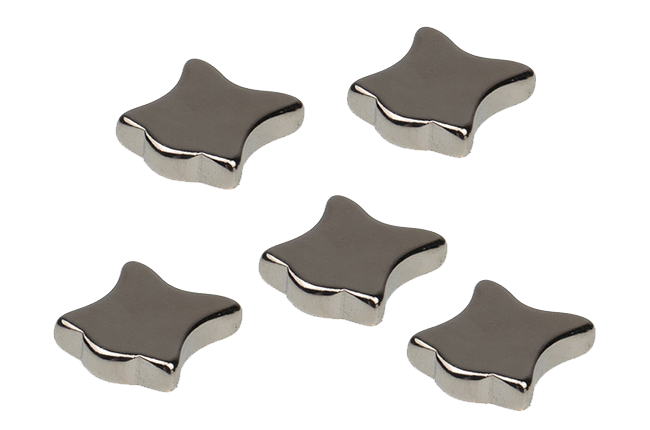
1. Sintered NdFeB Magnets
Sintered magnets are the most common and powerful variety of NdFeB magnets. They are produced through a powder metallurgy process where raw materials are melted, jet-milled into a fine powder, pressed into a shape, and then fused together via heat (sintering) in a vacuum environment.
Key Characteristics:
Extremely High Magnetic Energy: They offer the highest (BH)max (Maximum Energy Product), often reaching up to 52 MGOe or higher.
Rigidity: They are very hard but brittle, making them prone to chipping or cracking.
Custom Shapes: Usually produced as blocks, rings, or discs. Complex shapes require precision diamond-tool grinding.
2. Bonded NdFeB Magnets
Bonded magnets are created by mixing NdFeB powder with a polymer binder (like epoxy or nylon) and then pressing or injecting the mixture into a mold.
Key Characteristics:
Intricate Shapes: Because they are molded, they can be made into complex geometries that would be impossible for sintered magnets.
Lower Magnetic Strength: The presence of the non-magnetic binder reduces the overall magnetic flux compared to the sintered type.
High Precision: They require little to no post-processing and exhibit excellent dimensional tolerances.
3. Hot-Pressed (Deformed) NdFeB Magnets
These are produced by hot-pressing NdFeB powder at high temperatures. This process aligns the nanocrystalline grains to achieve high magnetic density.
Key Characteristics:
Improved Thermal Stability: They often perform better at higher operating temperatures than standard sintered versions.
Limited Availability: This manufacturing method is less common and typically more expensive than sintering.
Grading and Temperature Resistance
When selecting NdFeB magnets, understanding the "Grade" is vital. Grades are typically labeled with a letter suffix that indicates the maximum operating temperature:
Grade Suffix Max Operating Temperature
N (Standard) Up to 80°C
M (Medium) Up to 100°C
H (High) Up to 120°C
SH (Super High) Up to 150°C
UH (Ultra High) Up to 180°C
EH (Extra High) Up to 200°C
The Importance of Coating
Because NdFeB magnets contain a high percentage of iron, they are highly susceptible to oxidation (rusting). To prevent this, they are almost always finished with a protective coating. Common options include:
Ni-Cu-Ni: Nickel-Copper-Nickel is the standard for most industrial uses.
Zinc: Provides a cost-effective but slightly less durable barrier.
Epoxy: Excellent for moisture resistance and electrical insulation.
Gold/Silver: Used primarily for medical or aesthetic applications.
Conclusion
Choosing the right type of NdFeB magnets depends entirely on your application's requirements for strength, shape, and temperature. Sintered magnets are the go-to for raw power, while bonded magnets offer the versatility needed for precision components in small motors and sensors.
Topping
Contact

We will contact you within 24 hours. ( WhatsApp/facebook:+86 15957855637)