
In the field of advanced materials and magnetic engineering, the bonded magnet has emerged as a transformative solution for applications requiring intricate shapes, high precision, and specific mechanical properties. Unlike traditional sintered magnets, which are created by fusing magnetic particles through heat and pressure, bonded magnets offer a unique versatility by combining magnetic powders with a non-magnetic polymer matrix.
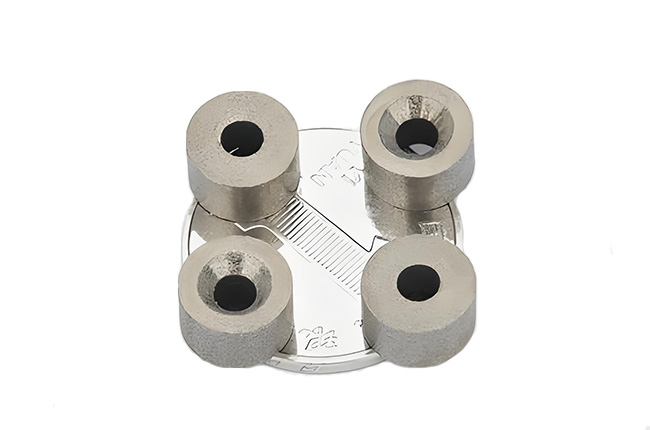
What is a Bonded Magnet?
A bonded magnet is a composite material consisting of a permanent magnetic powder—typically Neodymium Iron Boron (NdFeB), Samarium Cobalt (SmCo), or Ferrite—embedded within a thermoplastic or thermoset resin binder (such as nylon, epoxy, or PPS).
The fundamental advantage of this structure is that the magnetic properties can be tailored by adjusting the ratio of magnetic powder to binder, while the mechanical properties are largely determined by the polymer. This allows for the production of magnets that are less brittle than their sintered counterparts and can be formed into complex geometries that would otherwise require expensive machining.
Manufacturing Processes
The production of a bonded magnet generally follows one of four primary manufacturing routes, each offering different benefits regarding density and shape complexity:
Injection Molding: The magnetic powder and thermoplastic binder are mixed and injected into a mold. This process is ideal for high-volume production of highly complex shapes and allows for the integration of shafts or gears directly into the magnet.
Compression Bonding: The mixture (usually with an epoxy binder) is compacted under high pressure. This method allows for a higher loading of magnetic powder, resulting in superior magnetic performance compared to injection-molded versions.
Extrusion: Used primarily for flexible magnets or long strips, where the mixture is forced through a die to create a consistent cross-section.
Calendering: Specifically used for flexible sheets, common in sensors and magnetic displays.
Key Advantages and Limitations
While a bonded magnet may not achieve the absolute maximum energy product (BHmax) of a high-grade sintered magnet due to the presence of the non-magnetic binder, it provides several distinct engineering advantages:
Design Flexibility: They can be molded into thin-walled rings, arcs, or multi-polar configurations with extreme dimensional accuracy.
Corrosion Resistance: The polymer matrix acts as a protective barrier for the magnetic particles, often eliminating the need for additional coatings (especially in NdFeB variants).
Isotropic Properties: Most bonded magnets are isotropic, meaning they can be magnetized in any direction after forming, which simplifies the assembly process for complex motor designs.
Reduced Weight: The lower density of the composite material is beneficial in weight-sensitive industries like aerospace and portable electronics.
Modern Applications
The adoption of the bonded magnet is widespread across various high-tech sectors:
Automotive: Used in precision sensors, small DC motors (for seats, wipers, and mirrors), and brushless DC (BLDC) motors.
Consumer Electronics: Essential for hard disk drive (HDD) spindle motors, cooling fans, and haptic feedback components in smartphones.
Industrial Automation: Employed in encoders and stepper motors where high-speed rotation and low inertia are critical.
Conclusion
As industries push toward miniaturization and higher efficiency, the bonded magnet remains a critical component in the engineer's toolkit. By bridging the gap between high-performance magnetism and versatile plastic processing techniques, these materials enable the next generation of smart devices and efficient transport systems.
Topping
Contact

We will contact you within 24 hours. ( WhatsApp/facebook:+86 15957855637)