
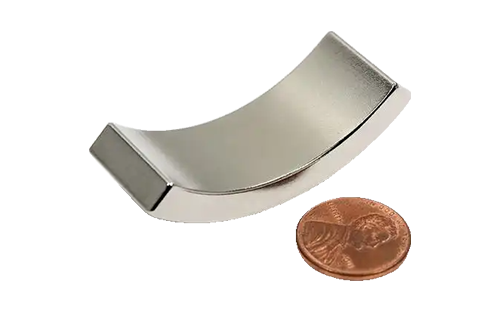
NdFeB magnets, also known as neodymium-iron-boron magnets, are the strongest permanent magnets available today. Their exceptional strength has made them essential in many industries, from consumer electronics to renewable energy. But how strong are NdFeB magnets really? Let’s explain it in a clear and practical way.
What Determines the Strength of an NdFeB Magnet?
The strength of an NdFeB magnet is mainly measured by several key magnetic properties:
Magnetic energy product (BHmax)
Residual flux density (Br)
Coercivity (Hc)
Among these, BHmax is the most commonly used indicator. It represents how much magnetic energy a magnet can store. NdFeB magnets typically have a BHmax range of 30 to 55 MGOe, which is significantly higher than ferrite or AlNiCo magnets.
In simple terms, higher BHmax means more power packed into a smaller magnet.
How Strong Are NdFeB Magnets Compared to Other Magnets?
To put things into perspective:
NdFeB magnets are up to 10 times stronger than ferrite magnets
They are stronger than AlNiCo and SmCo magnets in most standard applications
A small NdFeB magnet can outperform a much larger traditional magnet
This is why NdFeB magnets are often used when space is limited but high magnetic force is required. You could say they are “small but fierce.”
Pull Force: What Can NdFeB Magnets Hold?
The pull force of NdFeB magnets depends on their size, shape, and grade. For example:
A small disc magnet (10 mm diameter) can hold several kilograms
Larger industrial NdFeB magnets can support tens or even hundreds of kilograms
In motor applications, their strong magnetic field improves torque and efficiency
Of course, real-world holding force also depends on surface contact and material type. Smooth steel surfaces give the best results.
Magnet Grades: Why N52 Is Stronger Than N35
NdFeB magnets are classified into grades such as N35, N42, N48, and N52. The higher the number, the stronger the magnet.
N35: Standard strength, widely used
N42–N48: Higher performance, better efficiency
N52: One of the strongest commercially available grades
So when someone says, “This magnet is crazy strong,” it’s probably a high-grade NdFeB magnet.
Is There a Limit to Their Strength?
Yes, even NdFeB magnets have limits. Their strength can be reduced by:
High temperatures (standard grades lose magnetism above 80°C)
Improper handling or impact
Strong opposing magnetic fields
However, with proper grade selection and design, NdFeB magnets can maintain their strength for decades.
Conclusion
NdFeB magnets are extremely strong—far stronger than traditional permanent magnets. Their high magnetic energy, compact size, and efficiency make them ideal for advanced technology and industrial applications.
In short, if you need maximum magnetic power in a small space, NdFeB magnets are hard to beat. They are not just strong—they are game-changing.
Topping
Contact

We will contact you within 24 hours. ( WhatsApp/facebook:+86 15957855637)