
Magnets are one of the most intriguing phenomena in the natural world. From the simple compass needle to the complex motors in electric vehicles, the ability of magnets to exert force without physical contact is both fascinating and essential to modern technology.
To understand how magnets attract and repel, we must look beyond what the eye can see and explore the invisible forces known as magnetic fields.
The Foundation: Magnetic Poles
Every magnet, regardless of its size or shape, has two distinct ends called poles: a North Pole (N) and a South Pole (S). These poles are the regions where the magnetic force is strongest.
The Earth itself acts as a giant bar magnet, which is why the North pole of a compass needle points toward the Earth's magnetic North. This fundamental "two-pole" nature is a rule of physics; even if you break a magnet in half, you will not separate the poles. Instead, you will simply create two smaller magnets, each with its own North and South pole.

Why Do They Attract? (Opposites Attract)
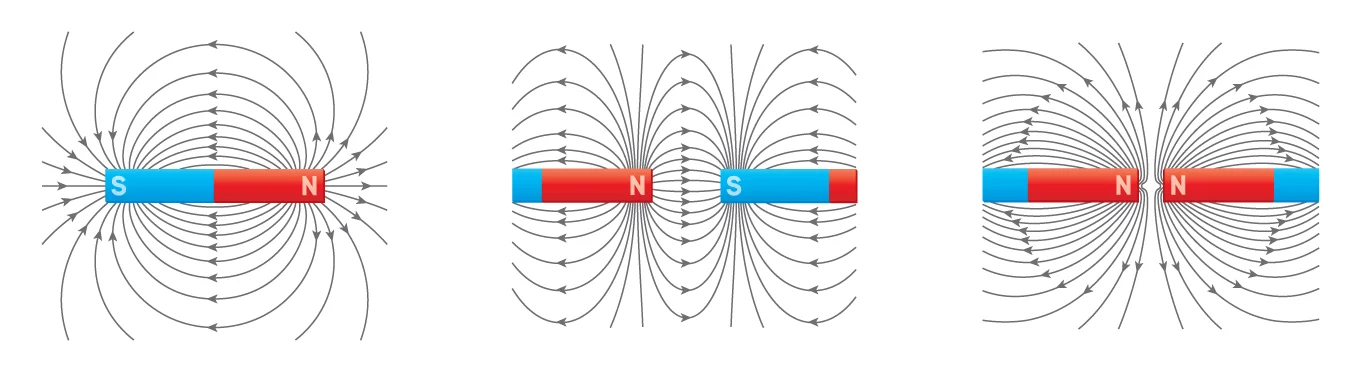
The phenomenon of attraction occurs when the North pole of one magnet is placed near the South pole of another. This happens because of the way magnetic field lines behave.
Direction of Flow: Magnetic field lines are invisible loops that "flow" out from the North pole and curve around to enter the South pole.
Creating a Bridge: When a North pole and a South pole face each other, their field lines naturally want to travel in the same direction. The lines from the North pole of the first magnet "bridge" the gap to the South pole of the second magnet.
The Resulting Pull: This creates a powerful, combined magnetic field that acts like a stretched rubber band, pulling the two magnets toward each other to shorten the distance the field lines have to travel.
Why Do They Repel? (Like Poles Repel)
When you try to push two identical poles together—such as North to North or South to South—you feel a distinct resistance. This is known as repulsion.
Conflicting Fields: Because magnetic field lines always flow from North to South, two North poles facing each other are essentially trying to "pump" force into the same space from opposite directions.
The Pushing Force: Instead of merging, the field lines from both magnets bend away from each other. They act like two opposing streams of water hitting head-on, creating a "wall" of magnetic pressure that pushes the magnets apart.
The Atomic Secret: Why Is Anything Magnetic?
To understand why these forces exist, we have to look at the atomic level. Everything is made of atoms, and atoms contain electrons.
Electron Spin: Electrons spin around the nucleus of an atom. This movement of electric charge creates a tiny magnetic field called a "magnetic moment."
Magnetic Domains: In most materials, like wood or plastic, these electrons spin in random directions, canceling each other out. However, in "ferromagnetic" materials like iron, nickel, and cobalt, the electrons can be aligned.
Alignment: In a permanent magnet, billions of atoms align their magnetic fields in the same direction. These groups of aligned atoms are called magnetic domains. When all the domains point the same way, the entire object becomes a magnet with a collective North and South pole.
Magnetic Force and Distance
The strength of attraction or repulsion is heavily dependent on the distance between the two magnets. This is governed by the Inverse Square Law.
If you double the distance between two magnets, the magnetic force doesn't just drop by half—it drops to one-fourth of its original strength. This explains why a magnet might feel like it has no effect on a refrigerator until it gets within an inch or two, at which point it suddenly snaps into place.
Fun Fact: The strongest magnets in the world, Neodymium magnets, use a specific crystalline structure (Nd₂Fe₁₄B) that makes it very difficult for their magnetic domains to be knocked out of alignment, which is why they stay powerful for decades.
Topping
Contact

We will contact you within 24 hours. ( WhatsApp/facebook:+86 15957855637)