
Neodymium magnets, also known as NdFeB magnets, are the strongest permanent magnets commercially available today. They are widely used in electric vehicles, wind turbines, consumer electronics, medical devices, and industrial motors. One common question is: why is boron included in neodymium magnets, even though it makes up only a very small percentage of the material?
The answer lies in materials science, crystal structure, and magnetic performance.
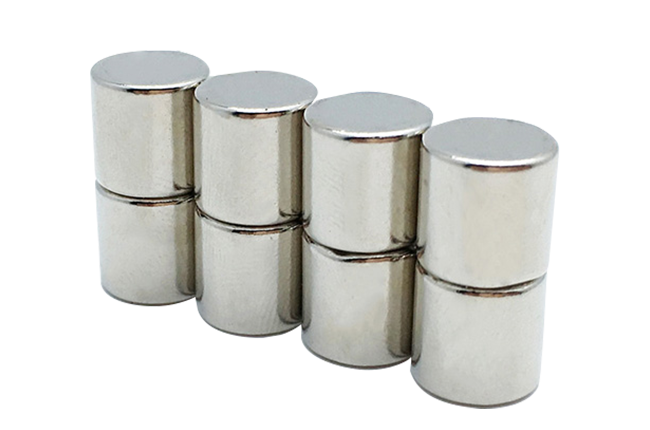
What Are Neodymium Magnets Made Of?
Neodymium magnets are primarily composed of three elements:
Neodymium (Nd) – a rare earth element responsible for strong magnetic properties
Iron (Fe) – provides high magnetic strength
Boron (B) – stabilizes the crystal structure and enhances performance
The typical chemical formula is Nd₂Fe₁₄B.
Although boron accounts for less than 1% by weight, it plays a critical role in making these magnets practical and powerful.
The Role of Boron in NdFeB Magnets
1. Stabilizing the Crystal Structure
Boron is essential for forming the Nd₂Fe₁₄B crystal phase, which is the key magnetic phase in neodymium magnets.
Without boron, neodymium and iron tend to form unstable or weakly magnetic compounds
Boron helps create a stable tetragonal crystal structure
This structure allows strong magnetic alignment at the atomic level
In simple terms, boron makes the magnet’s internal structure possible.
2. Increasing Magnetic Strength
Boron indirectly contributes to the magnet’s exceptional strength by:
Enabling high magnetocrystalline anisotropy
Allowing iron atoms to align more effectively
Supporting extremely high maximum energy product (BHmax)
This is why neodymium magnets are much stronger than ferrite or AlNiCo magnets of the same size.
3. Improving Coercivity (Resistance to Demagnetization)
Another key reason boron is used in neodymium magnets is its impact on coercivity.
Coercivity is the magnet’s resistance to losing magnetism
Boron helps refine grain boundaries in the microstructure
This prevents magnetic domains from reversing under heat or external fields
As a result, NdFeB magnets maintain performance even in demanding applications.
4. Enabling Miniaturization of Devices
Because boron helps maximize magnetic efficiency, manufacturers can:
Use smaller magnets for the same magnetic force
Reduce weight and size of motors and electronics
Improve energy efficiency in modern technologies
This is especially important in electric vehicles, smartphones, and renewable energy systems.
What Happens Without Boron?
If boron were removed:
The Nd₂Fe₁₄B phase would not form
Magnetic strength would drop dramatically
The material would be unsuitable for permanent magnets
In short, neodymium magnets would not exist without boron.
Why Such a Small Amount Is Enough
Boron works at the atomic and structural level, not as a primary magnetic contributor. Even a trace amount is enough to:
Lock iron and neodymium into the correct crystal lattice
Control grain growth during sintering
Optimize magnetic performance
This is why boron is indispensable despite its low concentration.
Conclusion
Boron is a key enabler of neodymium magnet technology. Although it is only a minor component by weight, it plays a major role in:
Stabilizing the NdFeB crystal structure
Enhancing magnetic strength
Improving resistance to demagnetization
Enabling compact, high-performance magnetic devices
Without boron, modern high-efficiency motors, wind turbines, and electric vehicles would not be possible. Its inclusion is a perfect example of how small elements can have a massive technological impact.
Topping
Contact

We will contact you within 24 hours. ( WhatsApp/facebook:+86 15957855637)