
Magnets play an important role in modern science and everyday life. From electric motors and medical equipment to simple refrigerator magnets, they are everywhere. But if we look at magnets from a scientific point of view, they can be classified into four main types.
So, what are the 4 types of magnets? Let’s break them down in a clear and professional way—without making things overly complicated.
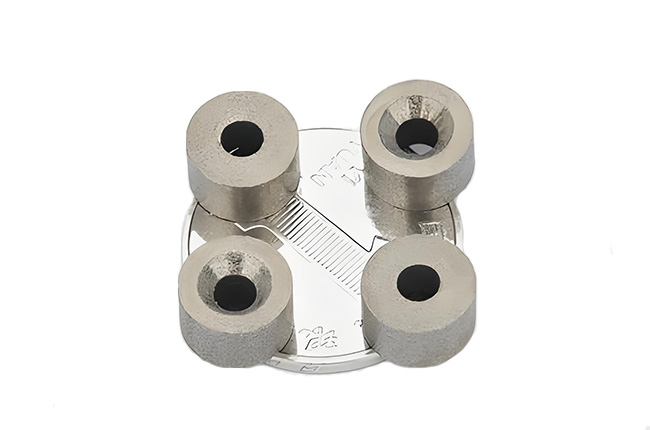
1. Permanent Magnets
Permanent magnets are magnets that retain their magnetic field over time without the need for an external power source. Once magnetized, they stay magnetized under normal conditions.
Key Characteristics:
Produce a constant magnetic field
Do not require electricity
Long-lasting and stable
Common Examples:
Neodymium magnets (NdFeB)
Ferrite (ceramic) magnets
Alnico magnets
Samarium cobalt magnets
Typical Applications:
Electric motors and generators
Loudspeakers and headphones
Sensors and measuring devices
In simple terms, permanent magnets are the “always-on” type of magnet.
2. Temporary Magnets
Temporary magnets only become magnetized when they are exposed to an external magnetic field. Once the field is removed, they quickly lose most or all of their magnetism.
Key Characteristics:
Weak magnetic retention
Easily magnetized and demagnetized
Usually made from soft iron or similar materials
Common Examples:
Iron nails
Paper clips
Soft iron cores
Typical Applications:
Electromagnetic devices
Electrical transformers
Scientific demonstrations
They’re magnetic only when you need them to be—nothing more, nothing less.
3. Electromagnets
Electromagnets generate a magnetic field when an electric current flows through a coil of wire, usually wrapped around an iron core. When the current stops, the magnetic field disappears.
Key Characteristics:
Magnetic strength can be controlled
Can be switched on and off
Very strong compared to their size
Common Applications:
MRI machines
Electric motors and relays
Magnetic cranes
Industrial automation systems
Electromagnets are powerful and flexible, but they need electricity to work.
4. Superconducting Magnets
Superconducting magnets are a special type of electromagnet made from superconducting materials. When cooled to extremely low temperatures, these materials conduct electricity with zero resistance, allowing very strong magnetic fields to be generated efficiently.
Key Characteristics:
Extremely strong magnetic fields
Very high energy efficiency
Require cryogenic cooling
Common Applications:
Particle accelerators
MRI scanners
Scientific research facilities
These magnets are not something you’ll find at home, but in high-tech environments, they are essential.
Why Understanding Magnet Types Matters
Each type of magnet has its own strengths, limitations, and ideal use cases. Engineers and scientists choose magnets based on factors such as strength, control, temperature, and cost.
In other words, magnets are not one-size-fits-all—and that’s a good thing.
Conclusion
So, what are the four main types of magnets?
Permanent magnets
Temporary magnets
Electromagnets
Superconducting magnets
From everyday consumer products to advanced scientific research, each type plays a unique role. Understanding these differences helps you choose the right magnet for the right application—and makes the world of magnetism a lot clearer.
Topping
Contact

We will contact you within 24 hours. ( WhatsApp/facebook:+86 15957855637)