
Neodymium Iron Boron (NdFeB) magnets are widely recognized as the world’s strongest permanent magnet material. Since their commercial introduction in the 1980s, NdFeB magnets have transformed modern technology by enabling smaller, lighter, and more efficient devices across a wide range of industries. This article explores what NdFeB magnets are, why they are so powerful, and how they are used in today’s world.
What Is NdFeB?
NdFeB stands for Neodymium (Nd), Iron (Fe), and Boron (B). These three elements form a crystalline structure known as Nd₂Fe₁₄B, which gives the material its exceptional magnetic properties. Among all commercially available permanent magnets, NdFeB magnets exhibit the highest magnetic energy product, often referred to as BHmax. This characteristic directly relates to how much magnetic energy a magnet can store.
Compared with traditional magnet materials such as ferrite or AlNiCo, NdFeB magnets can generate significantly stronger magnetic fields in much smaller volumes. This advantage has made them essential in applications where space, weight, and efficiency are critical factors.
Why NdFeB Is the Strongest Permanent Magnet
The extraordinary strength of NdFeB magnets comes from both their chemical composition and crystal structure. Neodymium is a rare earth element with strong magnetic anisotropy, meaning its magnetic moments prefer to align in a specific direction. When combined with iron, which contributes high magnetic saturation, the resulting compound achieves an exceptional balance of strength and stability.
In practical terms, NdFeB magnets can be several times stronger than ferrite magnets of the same size. This allows engineers to reduce component size without sacrificing performance, a key reason for their widespread adoption in advanced technologies.
Key Properties of NdFeB Magnets
NdFeB magnets are known for several defining properties:
High magnetic strength: They offer the highest energy density of any permanent magnet material.
Compact size: Strong magnetic output allows for miniaturization of devices.
Customizable grades: Different grades are available to suit specific performance and temperature requirements.
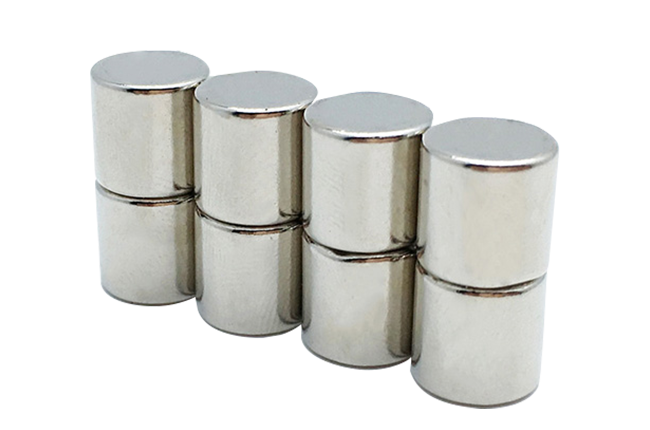
Surface coatings: Common coatings such as nickel, zinc, or epoxy are used to protect against corrosion.
However, NdFeB magnets also have limitations. They are more brittle than some other magnet types and are susceptible to corrosion if left unprotected. In addition, standard NdFeB magnets can lose magnetic performance at high temperatures, although specialized high-temperature grades have been developed to address this issue.
Manufacturing Process of NdFeB Magnets
The production of NdFeB magnets is a highly controlled process. It typically begins with melting the raw materials under vacuum or inert gas to prevent oxidation. The alloy is then rapidly cooled, crushed into fine powder, and aligned in a strong magnetic field before being pressed into shape.
After sintering at high temperatures, the magnets are machined to precise dimensions and coated for protection. Finally, they are magnetized using an extremely strong magnetic field. Each step in this process directly affects the magnet’s final performance, making quality control essential.
Applications of NdFeB Magnets
NdFeB magnets are used in a vast range of industries due to their superior performance. Some of the most common applications include:
Consumer Electronics
Smartphones, headphones, hard disk drives, and speakers all rely on NdFeB magnets for compact and powerful magnetic performance. Their use enables slim designs and high sound quality.
Renewable Energy
Wind turbines use large NdFeB magnets in generators to improve efficiency and reduce maintenance. These magnets play a critical role in advancing clean energy technologies.
Automotive Industry
Electric vehicles (EVs) and hybrid vehicles depend heavily on NdFeB magnets in traction motors, power steering systems, and sensors. Their strength contributes to higher efficiency and better vehicle performance.
Industrial and Medical Equipment
NdFeB magnets are used in robotics, automation systems, MRI machines, and precision instruments, where reliable and strong magnetic fields are essential.
NdFeB and the Future of Technology
As technology continues to evolve, the demand for NdFeB magnets is expected to grow. Trends such as electrification, renewable energy expansion, and smart manufacturing all rely on high-performance magnetic materials. Ongoing research focuses on improving temperature resistance, reducing reliance on heavy rare earth elements, and enhancing recyclability.
Sustainability is also becoming an important topic in the NdFeB industry. Recycling technologies are being developed to recover neodymium and other valuable elements from used magnets, helping to reduce environmental impact and stabilize supply chains.
Conclusion
Exploring NdFeB reveals why it is considered the world’s strongest permanent magnet material. With unmatched magnetic strength, versatile applications, and a crucial role in modern and future technologies, NdFeB magnets have become indispensable in today’s industrial landscape. As innovation continues, NdFeB will remain at the core of advancements that shape how we live, work, and generate energy.
Topping
Contact

We will contact you within 24 hours. ( WhatsApp/facebook:+86 15957855637)