
The magnet is a staple of science, industry, and everyday life, constantly fascinating us with its invisible force. One of the most common questions that arises when experimenting with these remarkable materials is: Does stacking a magnet on top of another actually make it stronger?
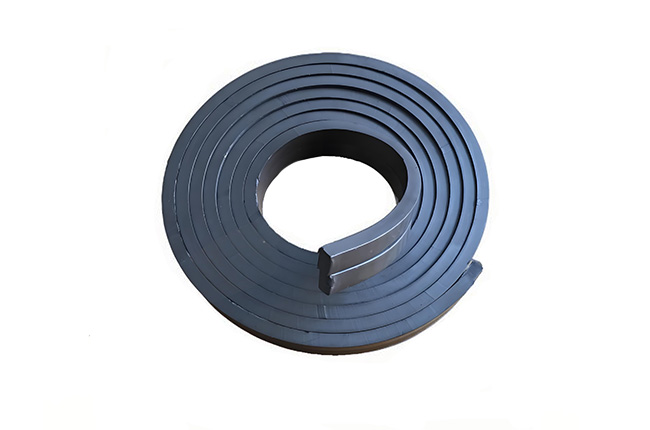
The simple answer is Yes, stacking multiple magnets together can increase their overall magnetic strength and performance. However, the phenomenon is more complex than simply adding up the power of the individual pieces. Understanding the physics behind this will help you maximize the magnetic potential of your materials.
The Science of Stacking
When you stack two or more magnets, particularly disc or block-shaped ones, with their poles aligned (North-to-South, North-to-South, etc.), they begin to function magnetically as a single, larger magnet.
Field Additivity: The magnetic fields of the individual magnets combine and reinforce one another. This merging of field lines increases the overall magnetic flux, which is the measure of the total magnetic field passing through a given area. The result is a stronger pull force and a magnetic field that extends further into space.
Creating a Longer Magnet: Two identical magnets stacked together effectively create a single magnet with the same diameter/width but double the thickness/length. For instance, stacking two 2mm-thick magnets results in the equivalent of a single 4mm-thick magnet. Generally, thicker magnets are stronger than thinner ones of the same material and diameter.
The Point of Diminishing Returns
While stacking boosts performance, this increase is not limitless, and the relationship is not always linear. You won't necessarily double the pull force by doubling the number of magnets.
Optimal Ratio: The most significant gains in strength occur until the total length (height of the stack) is approximately equal to the diameter or width of the magnet. Up to this point, the increase in pull force is substantial.
The Logarithmic Effect: Once the stack's length exceeds its diameter, each additional magnet provides only a marginal, smaller performance boost. This is known as the law of diminishing returns. The extra magnetic material added is increasingly farther from the object you are trying to attract, and since magnetic force decreases rapidly with distance, its contribution to the overall pull force becomes less impactful.
Material Saturation: Every magnet material has a saturation point—a maximum level of magnetization it can hold. Stacking is a way to effectively increase the size of the magnet, but you are not re-magnetizing the material beyond its physical limits.
When Stacking is Ineffective
It is crucial to ensure that the magnets are stacked with opposite poles touching (North to South). If you accidentally stack them with like poles facing each other (North to North), the fields will repel and cancel each other out, leading to a significant decrease in total strength.
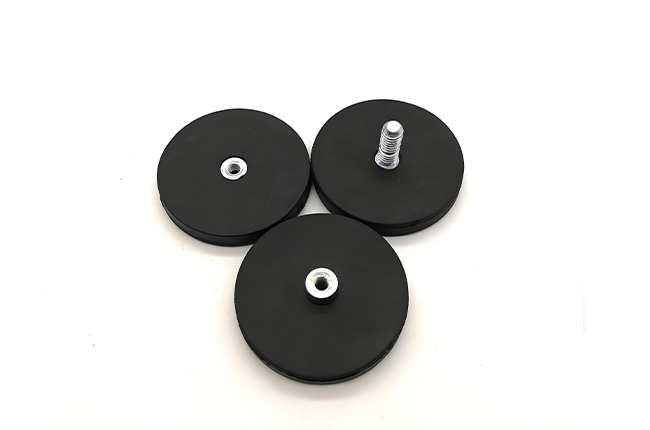
In conclusion, stacking a magnet is a practical and effective way to increase magnetic strength for specific applications, especially when a single, larger piece is unavailable. It transforms several small magnets into one more powerful unit, but smart stacking means knowing when to stop to get the most efficient strength-to-cost ratio.
Topping
Contact

We will contact you within 24 hours. ( WhatsApp/facebook:+86 15957855637)